Matching a Countertop Surface to Each Part of an Austin House
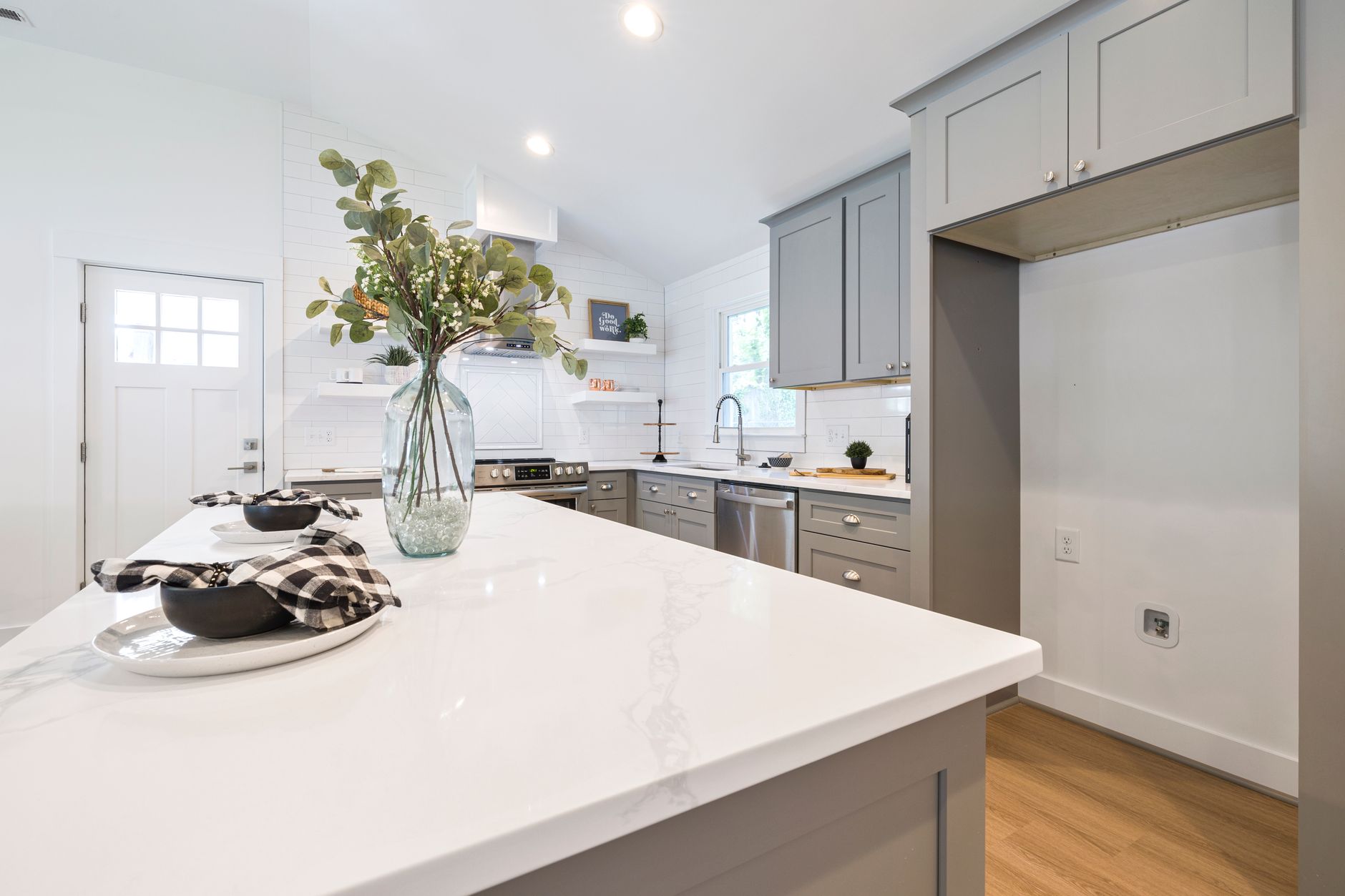
Engineered quartz does not suit every counter in an Austin house equally. It excels where a surface needs to resist stains and ignore sealing, and it struggles where heat or sunlight is heavy. Walking through a house room by room shows where it belongs, and a short table makes the pattern easy to see.
Where does engineered quartz fit in a typical Austin house?
| Location | Main stress | How engineered quartz copes | Better alternative if it struggles |
|---|---|---|---|
| Kitchen island away from glass | Spills, daily wear | Very well, no sealing needed | Not needed |
| Perimeter run beside the range | Hot pans, oven heat | Fair, trivets required | Granite or quartzite |
| Counter under a west window | Direct afternoon sun | Fair, pale colors can shift | Darker slab, or granite |
| Bathroom vanity | Water, toothpaste, cosmetics | Very well | Not needed |
| Laundry room top | Detergent, folding wear | Well | Laminate for a plain top |
| Covered patio bar | Weather, sun, grill heat | Poorly, made for indoor use | Granite or porcelain slab |
| Open outdoor kitchen | Full sun, rain, temperature swings | Not suitable | Porcelain slab or granite |
The table is a starting point. A house's orientation, the age of the cabinets and the way a household cooks can shift any row.
Why does the kitchen island often suit quartz best?
An island sits in the middle of the room, usually away from windows and away from the range, so it avoids the two conditions quartz dislikes. It takes the most daily life, from homework to party platters, and it is the place where a surface that never needs sealing earns its reputation. Islands in newer homes around Mueller are often the longest single piece in the house, which makes seam placement the main design question rather than the material.
A good fabricator pulls matching slabs from one lot and lays them out before cutting. The seam goes over a solid cabinet rail, away from the sink cutout. An island with a waterfall edge adds two mitered corners that need a clean pattern match, and quartz handles that well because its pattern repeats from slab to slab.
What changes along the cooking wall?
The run beside the range is the hot zone. Resin softens before stone does, so a pan fresh off a burner can scorch a quartz surface. A trivet by the range solves it for most cooks. Households that sear steaks on cast iron every night, or run an oven for hours through a hot week, sometimes choose granite or quartzite for the cooking wall and keep quartz for the island.
The cutout for a cooktop is also the part of the slab under the most stress. Corners should be rounded, and the narrow strip at the front of the cutout needs to be wide enough to carry the load. A fabricator checks these on the template before the saw touches the slab.
How does sun through glass change the decision?
Austin gets long, strong summers, and glass lets the ultraviolet through. A white or cream quartz under an unshaded west window can take on a warm yellow cast over several years, and the change shows most where a toaster or a bowl once shaded the surface. Mid tones and patterned slabs hide it better. Blinds, a deep overhang outside or a tree that shades the glass in summer all reduce the effect.
Houses near Barton Springs Pool and along Bouldin Creek often have mature pecans and live oaks that shade the glass for much of the day, which helps. Newer builds on open lots in the Texas Hill Country edge have less shade and more glass, so the same slab behaves differently there.
What about bathrooms and laundry rooms?
A bathroom vanity is the easiest job for quartz. Water, soap, toothpaste and makeup all wipe off a closed surface, and an undermount sink gives a clean line with no rim to catch grime. The only caution is a hot curling iron or a flat iron left on the surface, which can scorch resin as readily as a pan. A heat mat under hair tools prevents it.
A laundry top takes detergent, bleach splashes and the wear of folding, and quartz handles all three with less fuss than laminate. A remnant from a larger job is often enough for a small laundry counter, and the leftover piece from a kitchen island can find a second use there.
How do older houses affect the choice?
Bungalows in Hyde Park, Tarrytown and Travis Heights have walls that lean, floors that slope and cabinets that have settled over the decades. Quartz is rigid and unforgiving, so it needs a level base. A crew that arrives to template after the cabinets are shimmed gets a better fit than one working from a drawing. The gap along the back wall is closed with a flexible caulk or hidden by a backsplash, and the counter edge may need scribing to follow the plaster.
Older kitchens are also smaller, so a single slab usually covers the whole run and no seam is needed. That is one more reason the material suits them, provided the range and window are placed with the same care as in a bigger room.
How does care differ from one spot to the next?
The island and the vanity need only soap and water. The cooking wall needs a trivet habit more than a cleaning routine. A sunny counter benefits from a shade pulled down at midday, and a patio-side counter needs the grit wiped off before anything is dragged across it. Harsh chemicals such as oven cleaner and paint stripper attack the resin anywhere in the house, so they stay away from every quartz surface.
Hard water leaves white rings around the sink and the faucet base. The water in Austin picks up mineral on its way through the limestone country on both sides of the Balcones Fault, and polished quartz shows the spots plainly. A damp cloth after each use prevents most of them.
What should be settled before the slab is cut?
Three things decide most of the outcome: where the sun lands, where the heat comes from and where the seam falls. A site visit answers the first two in minutes, and the template answers the third. A slab chosen without those answers is a slab chosen on color alone, and color is the least of what the counter has to survive.
Bring the questions to the fabricator early. Which way does the glass face? How far is the range from the nearest window? Does the island fit on one slab? A crew that has worked in the neighborhood knows the answers for most of the older streets and many of the newer subdivisions.
Is there a simple way to decide?
Ask what the surface will face most. If the answer is spills and stains, quartz is a strong match. If the answer is a hot pan or a full afternoon of sun, look at granite, quartzite or porcelain for that spot. Many Austin kitchens end up with two materials, and the line between them usually falls at the range.
Engineered quartz fits the parts of an Austin house that need an easy, stain-proof surface indoors. Keep it out of direct sun and away from the burners.